
Town of Tonawanda Resident Lookup Records
Each record holds one fact. A Town of Tonawanda parcel record can tie a name to ownership or a tax-mail destination. A deed ties parties to a legal description. A directory edition places one listed person at one address in one year. Court and vital records answer to their own custodians. Access limits follow the custodian, so ask the question first and pick the record in the resident lookup that answers it.
| Record | What It Confirms | Where | Access |
|---|---|---|---|
| Town parcel or assessment | Recorded owner, tax-mail field, parcel and situs details | Town BAS portal and GIS | Public reference data; not occupancy proof |
| Recorded deed | Transfer parties, date, legal description, book or page | Erie County Clerk Browser View | Index access varies; copies and images may need a terminal or request |
| Historical directory | Listed name, address, occupation, or relationship in an edition | Buffalo & Erie County Public Library | Reference or licensed digital access |
| Court index | Party role, court, case type, year, and status | New York court portals and court clerks | Public index where supplied; confidential matters closed |
| Vital record | Official birth, death, marriage, or divorce event within access rules | Local registrar, NYS DOH, or Erie County Clerk | Eligibility and record type control access |
A shared name in one ZIP code proves nothing. For a historical household rather than a current record, the library's dated directory editions are the better tool. For a whole street at once, the Town of Tonawanda street directory follows an address-first trail through the residents directory records. Each path answers a different question.
Build a Town of Tonawanda Match
A defensible match rests on two independent keys. Preserve every spelling exactly as the source shows it. Note surname and given-name order, initials, middle names, O' or Mc variants, married and maiden surnames, and shortened street forms. Then compare pairs: address plus year, parcel plus name, deed party plus legal description, or directory address plus spouse or occupation. A property tax mailing field is only a lead. It never proves the owner lives at the parcel.
Erie County adds one complication for anyone tracing Town of Tonawanda deeds. The County Clerk's land-record system carries no address index. Identify the owner through the parcel system first, record the deed book, page, or file number, and only then return to the Clerk's party or book-and-page search. The online deed index begins in 1986. Deed images reach back to 1960, and older work can require alphabetical indexes, a public terminal, or a written request. This two-key rule keeps a modern address from being stamped onto the wrong historical record.
Town of Tonawanda Court Lookup Limits
For matters that land in Tonawanda Town Court, the clerk's window at 1835 Sheridan Drive in Buffalo, NY 14223 is the practical starting point. The court answers its phone at 716-876-5536. The court publishes no online party or docket interface for the public. Any request should carry the court's name. It should also carry the case number if it is known, the party's role, the year, and the exact document wanted. Be careful here. A Tonawanda City Court result is not interchangeable. That is a separate court with its own files.
WebCivil Local covers some local civil matters. It gives searchers a wide set of controls: party name, attorney, judge, role, court, case type, filing year, and open-versus-all status. Future appearances can be pulled. The court list accepts multiple selections, and output comes as HTML or PDF. Treat what it returns as a lead. Confirm the county, the court, the year, and the full file context before drawing any conclusion from it.
Note: A court index locates a case trail, not a verified current address or a final personal conclusion.
Reading Town of Tonawanda Court Results
Before ordering a file, save every field that makes a court result reproducible. WebCivil Local can display a case or index identifier, court, party names and roles, case type, status, filing year, appearance information, and document links when supplied. A name alone is weak evidence. An attorney address is not the party's address. A filing address may be purely historical.
| Case or index number | The identifier needed for a clerk request or later search. |
|---|---|
| Court and county | The venue that distinguishes Town Court, City Court, Supreme Court, or Surrogate's Court. |
| Party role | Plaintiff, defendant, or another role as the portal reports it. |
| Case type and status | The portal's category and active, restored, or other status label. |
| Filing year | The date context needed to test a same-name result. |
WebSurrogate offers several search modes. Name, file, old-index, index-book, and will searches are all supported. Permitted images generally begin with filings on or after February 19, 2014, older unrestricted material waits at a public-access court terminal, and sealed family, adoption, and juvenile files stay closed.
Verify Town of Tonawanda Resident Records
Anchor the name to a dated record first. Then seek a separate record that matches it. A court party, a deed party, and a directory occupant play different roles in a Town of Tonawanda resident lookup. A matching legal description can strengthen a deed match. A spouse notation or occupation can pull one directory entry away from a same-name neighbor. If sources conflict, preserve the conflict and check the underlying document before concluding anything.
- Record the name exactly as found and identify the question: owner, historical occupant, court party, estate participant, or a person's own registration check.
- Use the BAS or GIS parcel record only to capture the parcel, situs, owner, mailing distinction, and deed reference.
- Search the Clerk by party or book and page, or search a court portal by name plus court, county, and year.
- Compare a second key such as legal description, address and year, spouse notation, or case role before writing a limited finding.
- Request a custodian copy only when the record type and access rule allow it.
- Docket
- A court's running case record, which may show filings, appearances, and status rather than every underlying document.
- Index versus image
- An index identifies a record; an image is the underlying scan or document and may have different access rules.
- Certified copy
- A custodian-issued copy carrying the certification required when an official legal copy is needed.
Town of Tonawanda Vital Record Routes
Vital records are not a public browse system. For a local event, the Town Clerk or local registrar is the starting point. They field any certified-record question. The Town publishes no accessible page confirming those local operations. The New York State Department of Health handles statewide routes. The Erie County Clerk or court holds divorce decrees. State rules draw a firm line between genealogy copies and certified copies. Know which copy you need first.
| Record | Custodian Route | Current Browse | Genealogy Rule |
|---|---|---|---|
| Birth | Local registrar or NYS DOH | No unrestricted personal-name browse located | Generally 75 years, with known death; PHL §4174 |
| Death | Local registrar or NYS DOH | No unrestricted current browse located | Generally 50 years; PHL §4139 |
| Marriage | Issuing town clerk or NYS DOH | No unrestricted current browse located | Generally 50 years and both spouses known deceased; DRL §20 |
| Divorce | Erie County Clerk or court decree; NYS DOH certificate | Limited court or index route | A decree is a court record; a Certificate of Dissolution has a separate route |
The state genealogy path serves history, not a shortcut around a restricted certificate. It carries its own proof, fee, and timing rules. The Town publishes no certified-status page, so confirm local procedure with the registrar before sending a request. Ask first, then submit.
Town of Tonawanda Voter Privacy
The NYS Voter Lookup is a person's own registration and poll-site check. Its visible inputs include county, last name, first name, date of birth, ZIP, and address. It is not a browseable resident roster. A full voter-file request goes through the Erie County Board of Elections and is limited to an elections purpose under Election Law §3-103(5).
New York's public-facing VEDA system, created under Election Law §3-112 effective in 2026, excludes personally identifiable individual voter records. That is a meaningful system boundary, not a search defect. The Address Confidentiality Program under Executive Law §108 and protected voter registration under Election Law §5-508 can also prevent an ordinary result from displaying a physical address.
Note: A missing registration result can reflect protected status, timing, or nonregistration and does not disprove residence.
Lawful Town of Tonawanda Lookup Use
Official records have built-in stops. A parcel deed shows ownership, not occupancy. An estate file may carry access limits. A court name hit identifies nothing without context. Unclaimed-property results can surface a name, city, or ZIP, but the state withholds the dollar amount until proof arrives. Business and professional-license records add narrow public context, never a private conclusion about where someone lives in Town of Tonawanda.
The state registry listed here is not a person-finding tool for any residents directory. It is a safety and legal registry with a narrow scope. Online results cover Level 2 and 3 registrants. Level 1 and other categories follow different access channels. Registry status does not prove anyone lives in Town of Tonawanda, and the information must never be used to threaten, stalk, or harass a person.
The New York DCJS registry search presents the official safety-focused interface and its restrictions.
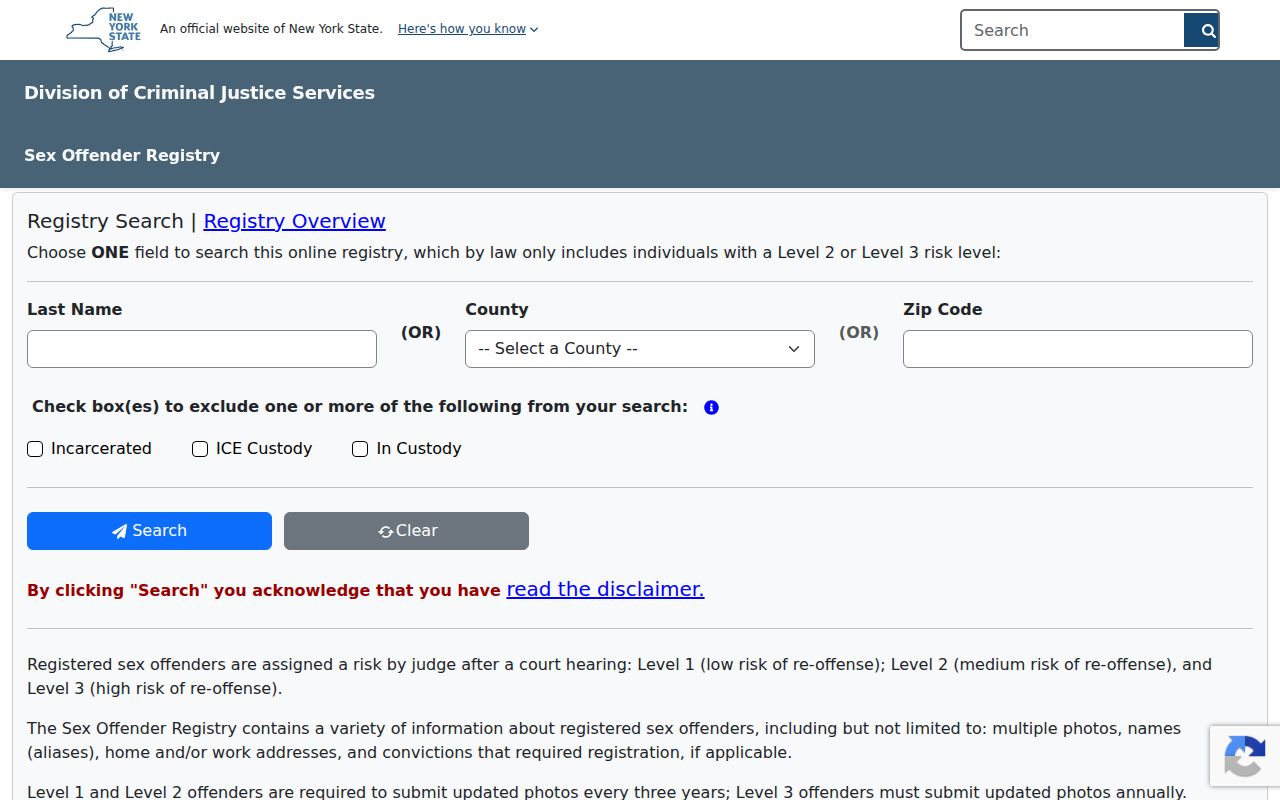
The registry screen shows why a controlled legal tool deserves to be read within its stated scope. It is not a general source for a Town of Tonawanda resident lookup or street directory.
Lawful use. Use a Town of Tonawanda resident lookup for a specific, lawful research purpose. New York records and registries must never be used to stalk, harass, intimidate, or harm another person.