
Town of Tonawanda Previous Residents by Era
Different sources cover different clocks. Begin with the current parcel and its recorded deed reference, then choose the source that fits the year being investigated. The Erie County Clerk preserves the long legal record, while the library’s directories and the federal census provide dated household context. Court and estate material can help explain a transfer or departure, but each has its own access limits.
| Source | Years it covers | Where held | What it shows |
|---|---|---|---|
| Erie deed index and deeds | Index 1986 to present; images 1960 to present; deeds 1808 to present | Erie County Clerk | Parties, instrument, book/page, legal description |
| Erie mortgages | Index 1986 onward; images 1980 onward; records 1840 onward | Erie County Clerk | Mortgage parties, assignments, satisfactions |
| Township directories | 1900/01, 1913, 1922, 1924, 1928, 1930 to 1942 | Buffalo & Erie County Public Library | Dated name, address, and local context |
| Tonawandas directories | 1948, 1951, 1952/53, 1955, 1957, 1958 to 1981, 1983, 1985 to 2000, 2000 to 2004, 2007 | Library reference collection | Name or address entries where available |
| Federal census | Public through 1950 | NARA, library, and authorized databases | Household as enumerated on its census date |
| Erie court index | Online 1993 onward; records 1957 onward; older material by request | Clerk and Records Center | Party, case, judgment, or estate leads |
For a more recent ownership question, use the deed and mortgage records first. For a historical household question, select the closest listed directory year and then compare it with the census. A gap between available editions is evidence of a gap, not proof that the address was empty.
Start Previous Residents With a Town Parcel
The Town GIS layer provides the bridge from a modern address to durable property identifiers. Record the situs address, owner and mailing distinction, SWIS, PARCELID, PrintKey, deed date, book/page, sale information, neighborhood and zone fields. These facts help distinguish a parcel from another address with similar wording. The current owner field is a research lead, not a complete history and not proof that the named owner occupies the location.
Use BAS when a bill, tax-map, address, or owner search fits the record in hand. BAS instructs address users to enter the number and street name without a suffix, and owner searches omit a middle initial. If a number or municipal label changes across time, the legal description, parcel clues, and deed book/page are often more stable than a postal string.
Town of Tonawanda’s No-Address Index Quirk
The central local obstacle is simple: Erie County Clerk Browser View does not index deeds by street address. It searches parties, instruments, book/page, legal description, map, parcel, and related fields. That means an address-only search will not produce a reliable prior-residents trail. The parcel owner and book/page must bridge the address into the Clerk’s grantor and grantee records.
In Browser View, enter a party as last name first without a comma. Narrow by Town, date range, document type, and direct-name filtering where useful. When a result is negative, try a spelling variant, the direct-name option, a different bounded date range, instrument number, book/page, parcel, or legal-description clue. Older deed work may require the Graves Index, older books, a public terminal, or a request.
Erie County Clerk Browser View is the official index route for that bridge.
Evidence Cards for Town of Tonawanda Addresses
A short evidence card keeps a deed chain from turning into a guess. For every backward step, write the target address, normalized street form, municipality label, parcel ID or SWIS or PrintKey, owner, deed date, instrument number, book/page, grantor, grantee, consideration, legal-description text, source URL, image or copy status, and search date. If a deed is corrected or replaced, retain both instrument numbers and the status note.
The card should also state the source role. “Recorded party” is not the same as “directory occupant,” “tax-mail recipient,” or “census household.” This distinction is especially important when a trust, estate, corporation, or attorney appears in a transfer. In those cases, an entity filing, Surrogate’s record, or Clerk business record may be the next lawful branch instead of an assumed individual match.
Trace Town of Tonawanda Previous Residents Through Deeds
The chain of title moves backward from the current parcel record to the purchase deed, then from that seller to the seller’s earlier acquisition. It is a property sequence, not a household list. Capture each deed’s legal description and parcel or map detail before moving to the next document, because street wording can change while those bridge keys preserve the match.
- Locate the parcel and record the current owner, situs, mailing distinction, legal clues, and deed book/page.
- Find the current owner’s purchase deed in Browser View by party or book/page, with a Town and date filter if helpful.
- Record the grantor, grantee, instrument number, deed date, consideration, and legal-description lines.
- Search the seller as a grantee in an earlier date range to locate that person’s purchase or other acquisition.
- Repeat the sequence, moving to older index books, terminal access, or a Clerk request when online coverage no longer fits the period.
- Grantor
- The party transferring an interest in a recorded document, commonly the seller in a deed.
- Grantee
- The party receiving an interest in a recorded document, commonly the buyer in a deed.
- Chain of title
- The dated sequence of recorded transfers used to trace interests in the same parcel.
- Legal description
- The parcel’s recorded land description. It can bridge documents when the street address or parcel configuration changes.
Note: The Clerk index has overlapping online coverage, so an available image and an available index entry do not always begin in the same year.
Erie County Documents Behind Previous Residents
The Clerk keeps deeds, mortgages, liens, judgments, maps, and other recorded instruments. Its official records page reports deeds from 1808 forward, mortgages from 1840 forward, an online land index from January 1, 1986, deed images from January 1, 1960, and mortgage images from January 1, 1980. It also lists court records, but online court indexing and ordinary image access are more limited. The older route may be an office, Records Center, terminal, or request rather than a browser result.
The Clerk’s records-kept overview is the source for those record groups and access boundaries.
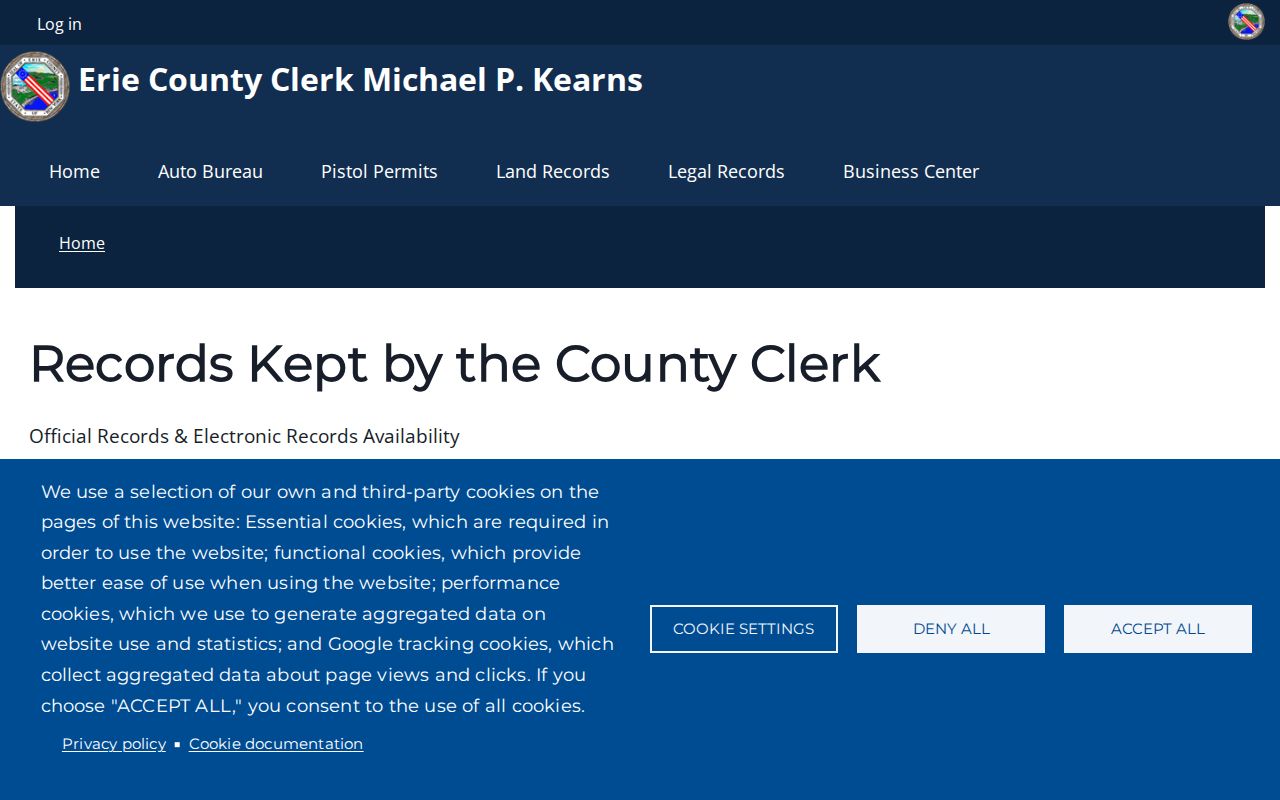
The coverage page is useful for choosing the next access route when a deed, mortgage, court item, or older book does not appear in the same online search.
For a certified deed, the Clerk’s request form asks for the name, property address, city/state/ZIP, phone, and approximate purchase date. The research file reports a $5 certified fee in person or $10 by mail including the search fee. Copy and certification charges vary by pages and delivery method, so confirm the current requirement with the Clerk before ordering.
Past Households in Town of Tonawanda Directories
Directories and census schedules run beside the deed chain rather than beneath it. A directory may list a person at the address who was not the owner. A census records a household on an enumeration date. A parcel field may show a later tax owner. Treat each as dated evidence with its own role. Pair the nearest directory years with 1900, 1910, 1920, 1930, 1940, and 1950 census research where appropriate, and leave the gaps visible.
The Buffalo & Erie County Public Library’s Grosvenor Room keeps its city directories as reference material. Closed-stack volumes may take 10 to 15 minutes to retrieve. Staff can perform up to five city or telephone directory lookups through the library request form, with an advertised response of three to five business days. The Town of Tonawanda city directory collections page details the edition runs and how address sections work.
Preserve the library’s regional label, whether it says Tonawanda Township, Tonawandas, Buffalo Northeast Suburban, or Erie County Suburban. Town, City of Tonawanda, Village of Kenmore, and postal-city labels are not interchangeable.
Town of Tonawanda Resident Trail Endpoints
When an owner dies, transfers through an estate, or disappears from a directory, an obituary, cemetery guide, or probate file may help explain the break. The Erie Surrogate’s Court offers a public estate index, although images are available only where permitted and confidential material remains restricted. A named heir or representative in an estate document is a historical record fact, not a current contact lead.
The Historical Society of the Tonawandas is listed at 113 Main Street, Tonawanda, NY 14150, telephone 716-694-7406. The research file verifies that it is a local-history specialist, but its research policies, fees, and any house-history service were not verified. The library’s maps, atlases, clippings, cemetery guides, and referrals are practical companions. Precise local Sanborn map years and shelf locations were not verified, so they should be confirmed with the repository rather than assumed.
Property Alert Is Not a History Record
Erie County Property Alert is a free monitoring tool for exact party-name and S-B-L matching. It can provide a useful notice when a watched name or identifier appears in a new filing, but it can miss documents that lack the selected name or S-B-L and it does not prevent fraud. Verification normally takes five to seven business days. It belongs beside a current research file, not in place of a checked deed chain.
If a notice or mailer names a property, verify the instrument through the official Clerk portal and obtain the appropriate copy from the custodian. A deed that contains a real address can still be connected to a misleading solicitation. The recorded document, status notes, and certified-copy route carry more weight than a third-party notice.
Limits on Town of Tonawanda Previous Residents
Past-resident research cannot identify every person who stayed at an address. Parcel fields are not occupancy proof. A deed does not list every household member, and a directory can omit people or use initials. Public census access ends with 1950. New York Address Confidentiality Program participants, protected voters under Election Law §5-508, restricted court material, and private utility or DMV information are not shortcuts around those limits.
Use the minimum information needed for a lawful family-history, estate, property, or civic question. Keep a record of the custodian and source date. When an underlying fact needs legal proof, request it from the office that holds it.
Lawful use. House-history research should not be used to track, threaten, or repeatedly contact a living person. New York Penal Law §120.45 and §240.26 address stalking and harassment conduct.