
Finding Town of Tonawanda Residents
No single official roster lists everyone in Town of Tonawanda. The question shapes the starting record. An address question usually begins with the Town assessment search or the parcel map. A transfer question belongs to the Erie County Clerk. A historical household question belongs with the Buffalo & Erie County Public Library. Court, vital, election, business, and license records can add context. But each has a separate access rule. A name hit is only a lead. Wait for a second dated record before trusting it.
A parcel field names an owner and a tax-mail recipient. That does not establish occupancy. A directory can place a person at an address, but only in that edition's year. Voter information has a self-service route and a controlled public-file route. The useful Town of Tonawanda residents directory process is a short chain of records. It is not a broad name list.
- Use the Town property search or GIS map to retain the site address, parcel key, and deed book or page when available.
- Search the Erie County Clerk by party, instrument, book and page, parcel, map, or legal description.
- Check a dated library directory or census record for a past household.
- Use a court, vital, business, or license index only for the narrow fact it can confirm.
- Ask the custodian for a copy, archive item, or FOIL record when the public index ends.
Town of Tonawanda Record Custodians
Three offices supply most of the trail behind a Town of Tonawanda residents directory search. The assessment system and Town GIS establish parcel context. The Erie County Clerk keeps land records. That office also holds several other record groups. The Board of Elections controls the limited voter-record channels. The Town is also distinct from the City of Tonawanda and the Village of Kenmore. Keep the jurisdiction printed on a source. Changing it to match a postal label can send a request to the wrong office.
Town Assessment and GIS
Town municipal building
2919 Delaware Avenue, Kenmore, NY 14217
Town Court records, vital certificates, library collections, and archival court files each run through their own channels. Some lack an online index. In that case, use the request form, counter, public terminal, library desk, or archive the custodian identifies. Do not assume another Tonawanda office holds the record.
Town of Tonawanda Parcel Starting Point
The Town GIS is a practical first step once an address is known. Its parcel layer separates the situs address from owner mailing fields. One query can surface SWIS, PARCELID, and PrintKey. It also shows deed date, book and page, sale information, assessed values, building characteristics, neighborhood code, zoning, school, fire, police, and ZIP context. These fields bridge offices nicely. They are not a legal survey, and they do not prove who lives at the property.
The Town BAS portal allows one search choice at a time. Enter the house number and street name without a suffix like Road or Street. Skip the middle initial in an owner search. Save the date of each result. Assessment and GIS fields can lag behind a conveyance.
| Town search field | Use | Boundary |
|---|---|---|
| Bill # | Find a tax-bill record | Not a deed identifier |
| Tax Map # | Connect a tax reference to a parcel | Keep with legal description |
| Property Address | Enter number and street only | Does not establish occupancy |
| Owner Name | Search without middle initial | Owner and resident differ |
| GIS owner and mail fields | Compare OWNER, MAILAD, and SITEADDRESS | Mailing data may be stale or outside Town |
Note: Keep the situs address, mailing address, and parcel identifier in separate notes so one field is never reported as another.
The map layers sit above the parcel data. The Town GIS portal page displays that public mapping service.
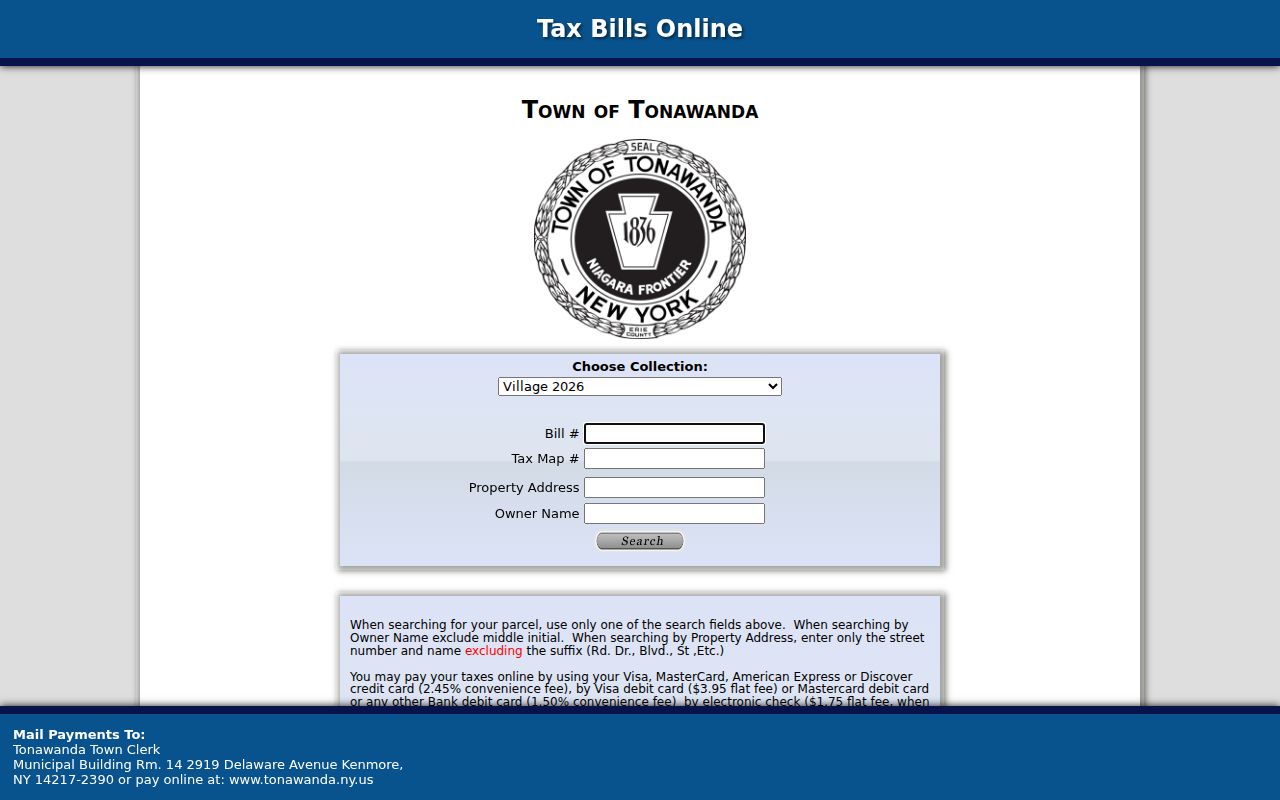
The options here make one thing clear. An assessor search supplies a structured property lead, not a complete resident roll.
Town of Tonawanda Deed Trail
The Erie County Clerk anchors the deed trail, with one local quirk. Its land-record system is not indexed by address. Start from the parcel owner and the deed book or page shown in the property system. Then move to the Clerk's party or book-and-page tools. Browser View also filters by instrument number, parcel, map, legal description, document type, Town, and date. For a party search, enter last name then first name without a comma. Use direct-name filtering when you follow land records.
The online deed index starts January 1, 1986. It runs to the present. Deed images reach back to January 1, 1960. Older work may need an alphabetical index, older books, a public computer, or a written request. A dead-end web search can simply mean the year or image sits behind another channel.
- Parcel
- A mapped tax property with identifiers that connect assessment and deed records.
- Index
- A finding aid that points to a record, not always the document image.
- Grantor and grantee
- The transferor and recipient named in a recorded instrument.
- Criss-cross directory
- An address section read from house number to listed occupant in a dated edition.
The Erie County Clerk Browser View is the official route for these index fields.
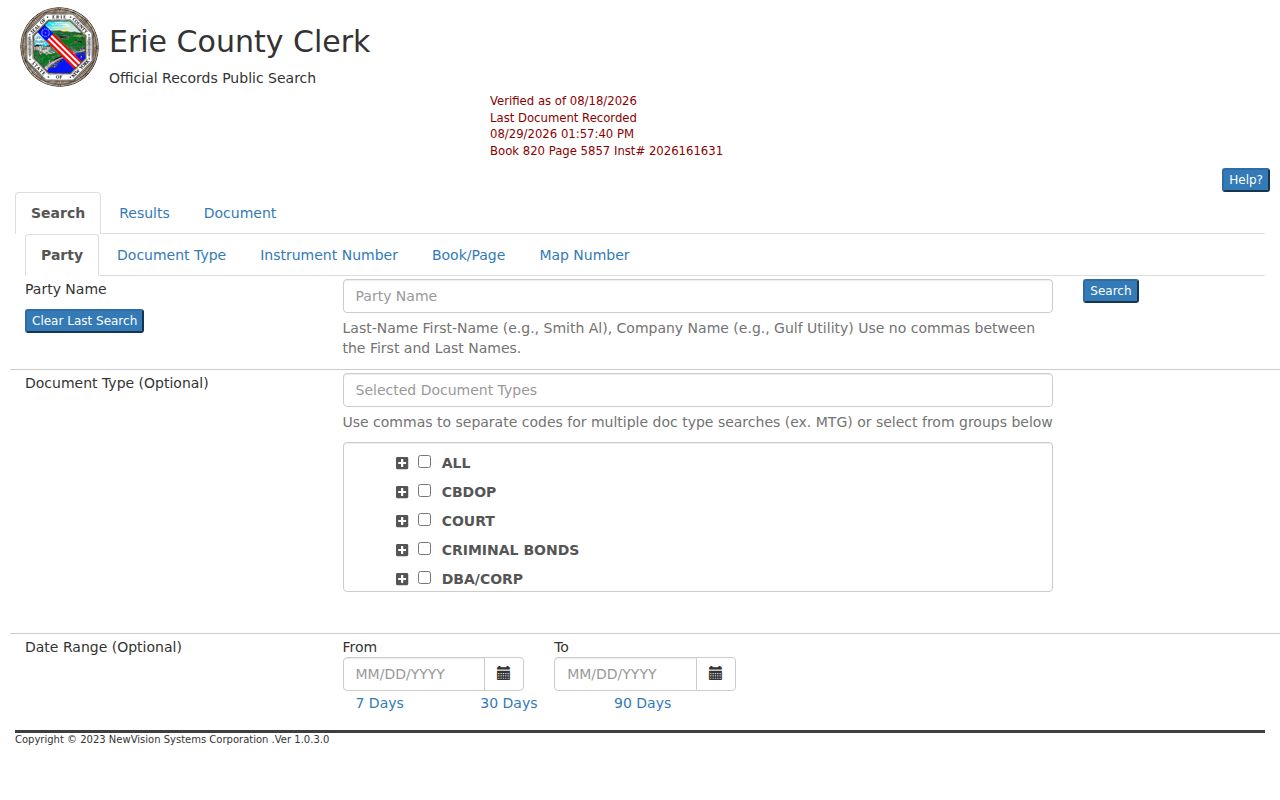
The visible search families tell the story. A parcel key and party name beat repeated street-address entries.
Current Town of Tonawanda Resident Sources
Current sources do not describe the same kind of person. A property roll names a recorded owner or tax-mail recipient. A deed index names people or entities tied to a transfer. Voter records cover registration, not households. Court, license, and business indexes answer narrow questions. None of them alone proves current residence.
| Local source | What it confirms | Custodian | Access route |
|---|---|---|---|
| Town assessment and parcel map | Parcel, owner fields, tax-mail fields, site details | Town and Erie real property services | Public BAS and GIS search |
| Recorded deeds and mortgages | Transfer parties, date, legal description, book/page | Erie County Clerk | Free index; image, terminal, request, or copy route varies |
| NYS Voter Lookup | A voter’s own registration and polling context | State Board of Elections | Identity-specific self lookup |
| Erie voter-file request | Permitted registration fields by requested geography | Erie Board of Elections | FOIL form, certification, fee, elections purpose |
| Library directory collections | Dated address and household context | Buffalo & Erie County Public Library | Reference, licensed, digitized, or staff request |
For one-person verification, compare two independent keys. Pair parcel with name, or directory address with year. The focused resident lookup follows that method without turning a database hit into a personal profile.
Town of Tonawanda Voter Access Rules
NYS Voter Lookup is a self-service form. You supply county, name, birth date, ZIP code, and address details. It exists so a registered voter can check registration, polling, or mail-ballot information. A match proves little by itself. So does an empty result. Neither outcome confirms where a person actually lives. A separate FOIL route to the Erie Board of Elections opens defined fields, geography, party selections, sort order, and a file format. The requester must state an elections purpose and certify the use is not directly or indirectly commercial. Protected voter data, full birth dates, signatures, and ballot choices never become street output. Election Law §3-103(5) governs that channel.
Town of Tonawanda Name Boundaries
Three governments share one name here. The Town of Tonawanda, the City of Tonawanda, and the Village of Kenmore are separate jurisdictions. The Town municipal building carries a Kenmore postal address. Town Court uses a Buffalo address. Older directory shelves may say Tonawanda Township, Tonawandas, Buffalo Northeast Suburban, or Erie County Suburban. Copy the wording each record carries. Then compare parcel, jurisdiction, and date before joining it to any other source.
ZIP codes deserve the same caution. The Town GIS legend names 14150, 14207, 14217, and 14223, while a separate Town reference service lists only three of those codes. For one street address, USPS lookup settles delivery. Still, a ZIP is a postal locator, never proof of municipal jurisdiction or residence.
Town of Tonawanda Directory Shelf
The Grosvenor Room holds the best local directory shelf. It sits at the Buffalo & Erie County Public Library. Its guide lists Tonawanda Township editions for 1900/01 through 1928. Those years are 1900/01, 1913, 1922, 1924, and 1928. Coverage then runs 1930 through 1942. A Tonawandas regional sequence runs 1948 through 2007, with gaps. Earlier Buffalo and Erie County volumes add 1870, 1901, 1902/03, 1917, and 1949 context. A gap is evidence, not permission. Never assume a continuous run from one volume to the next.
Everything is reference only. The guide says volumes stay in the room and never circulate. Closed-stack retrieval usually takes 10 to 15 minutes. Buffalo microfilm covers paper volumes too fragile to photocopy. Staff accept up to five targeted lookups. The full shelf and the criss-cross method live on the City Directory page.
Town of Tonawanda Record Comparisons
Commercial people-finders and official records answer different questions. A commercial entry may blend old directory lines, marketing data, parcels, and guesswork. Its date, method, and correction path often stay unclear. Official routes take a request or a library visit. But they name the custodian, source date, coverage limit, and copy status, which matters when an address, heir, transfer, or historical household needs careful checking.
| Research route | Best use | Key limit |
|---|---|---|
| Official parcel, Clerk, court, and agency records | Trace a defined fact to its keeper | May require a request, terminal, fee, or limited fields |
| Library and archive collections | Place a person or household in a dated historical source | Coverage gaps and edition access matter |
| Commercial compiled data | Generate questions to verify independently | Can be stale, merged, inferred, or hard to correct |
Write down three things. Record the custodian, the record date, and what a result fails to establish. That stops a tax-mail field, court party, or old directory line from passing as current residence.
Town of Tonawanda FOIL Requests
Some records never reach a public index. When that happens, ask the office that keeps them. New York's Freedom of Information Law, Public Officers Law Article 6, §§84 through 90, covers non-exempt agency records. An agency typically grants, denies, states it lacks the record, or acknowledges the request with a reasonable estimated date within five business days. Plain copies cost twenty-five cents per page. Sizes over 9 by 14 inches, or other media, bill at actual reproduction cost.
A Town request should name Town of Tonawanda, the record type, a narrow date range, and any relevant address or parcel facts. Clerk copy and search forms, Board of Elections requests, vital-record applications, library requests, and archive inquiries each run through separate channels. Name-and-address lists carry extra certification rules. Exemptions can force redaction. The Town online FOIL form asks for requester, subject, date, delivery method, address, description, and details.
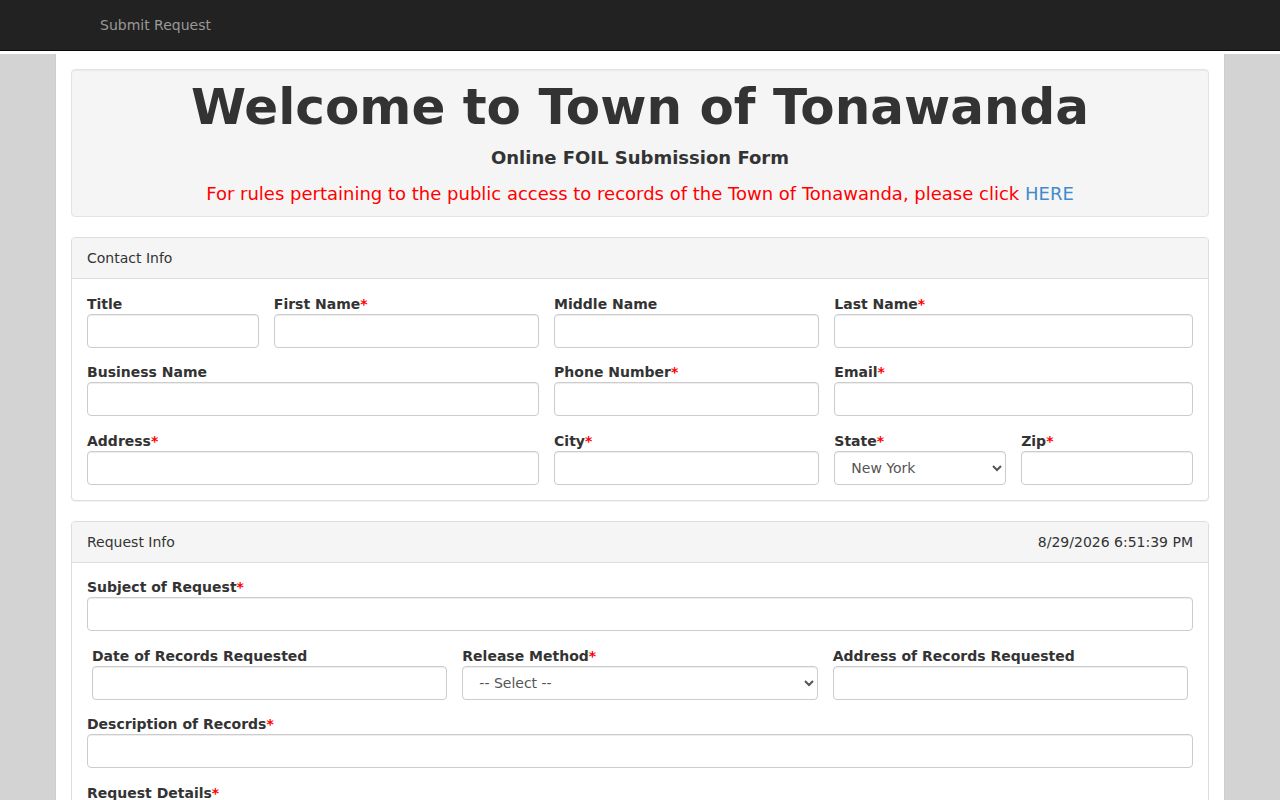
A narrow request gives the custodian a real trail. It does not ask the office to build a new resident list.
Town of Tonawanda Property Alert Check
Erie County's Property Alert is free. It lets a parcel owner follow recorded-document activity. The system watches exact party-name variants and S-B-L identifiers. Verification commonly takes five to seven business days. It cannot prevent fraud. A filing that lacks the watched name or S-B-L can slip past it. Treat a surprising notice carefully. Check it against the Clerk index and, if needed, a certified copy rather than an address contact.
The County's proposed 2026 budget funds Clerk land-record software modernization and ongoing deed-liber scanning, so online index results may grow over time. Note your access date on any current portal. Older books and images may still need another route. Erie County Property Alert explains the free enrollment path and its limits.
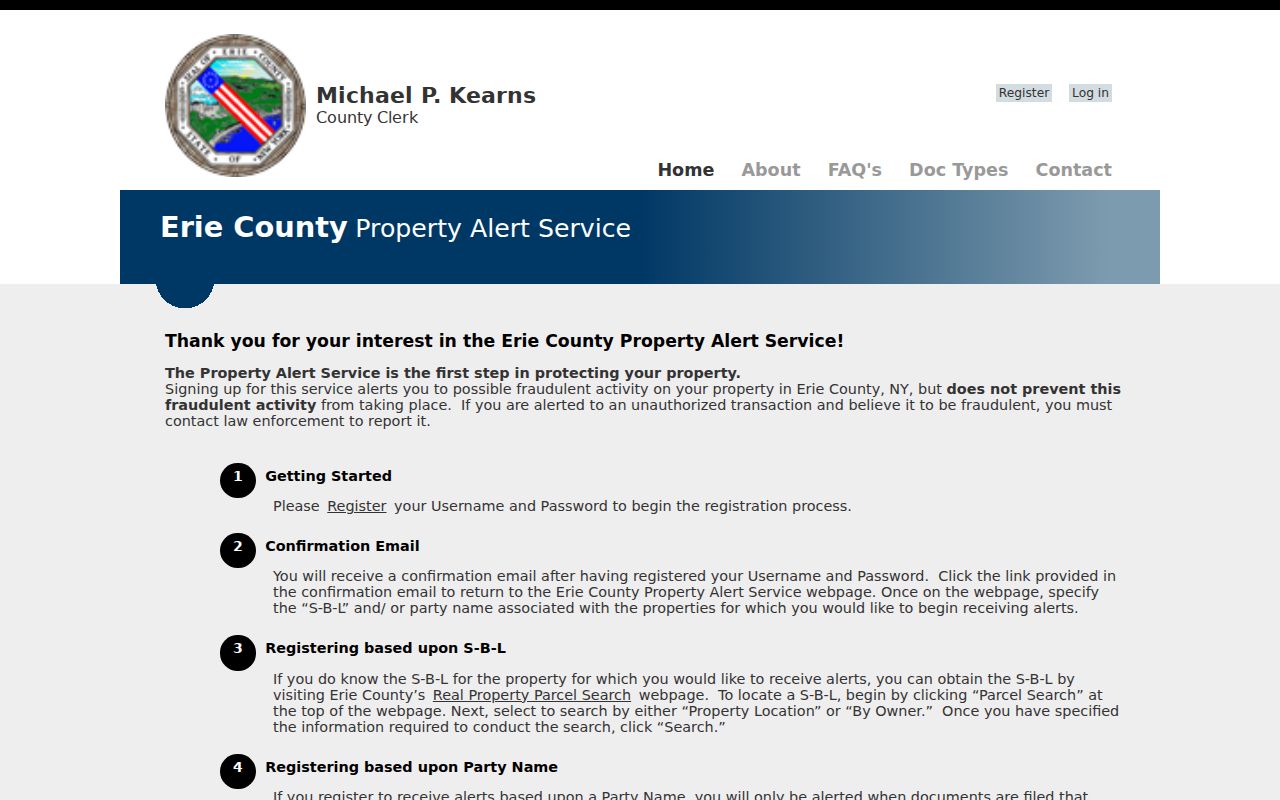
Property Alert is a notification aid. It is not proof of a transfer, and it never replaces reviewing the recorded instrument itself.
Historical Town of Tonawanda Directories
A dated Town of Tonawanda directory ties a printed name to an address or occupation. It may also note a spouse or some other household clue. Each edition tells its own story. Read it alongside the volume's abbreviation key. Compare the nearest edition too, since a street's households can shift between printings. The library guide also lists licensed digitized resources. Searching those works best when you put the number and street in quotation marks. Drop any suffix. Treat OCR as a finding aid only. The scanned page remains the record worth reading.
Directory years pair naturally with federal census years from 1900 through 1950. That pairing suits family history work. A historical directory line does not settle a current parcel question on its own. A deed or map bridge is a separate step. For an older household, the library, cemetery, and church may each hold the next source. So may the yearbook, obituary, and local-history referrals. Every one of them carries a different scope and privacy rule. Know it before you search.
Town of Tonawanda Name Search Limits
The New York State Comptroller's unclaimed-funds search is another narrow name-based lead. It accepts an owner or business name, with city and ZIP refinements available. The dollar amount stays hidden until proof and a claim are reviewed. The search is free. A match is not a current address. It should not support any private conclusion about a person. Its real value is pointing a claimant toward the State's official proof process. New York's unclaimed-funds search guidance walks through the official steps.
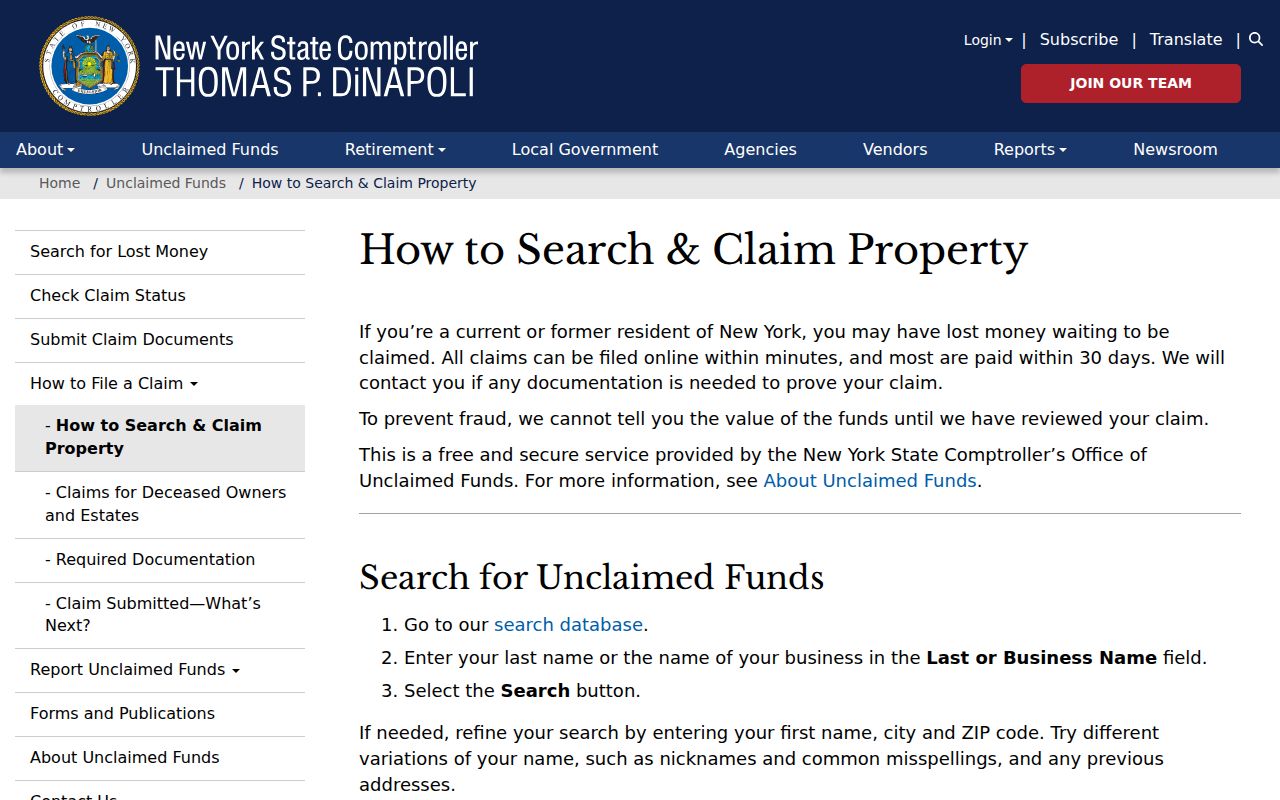
Use owner and place fields as search refinements, then follow the State’s proof requirements.